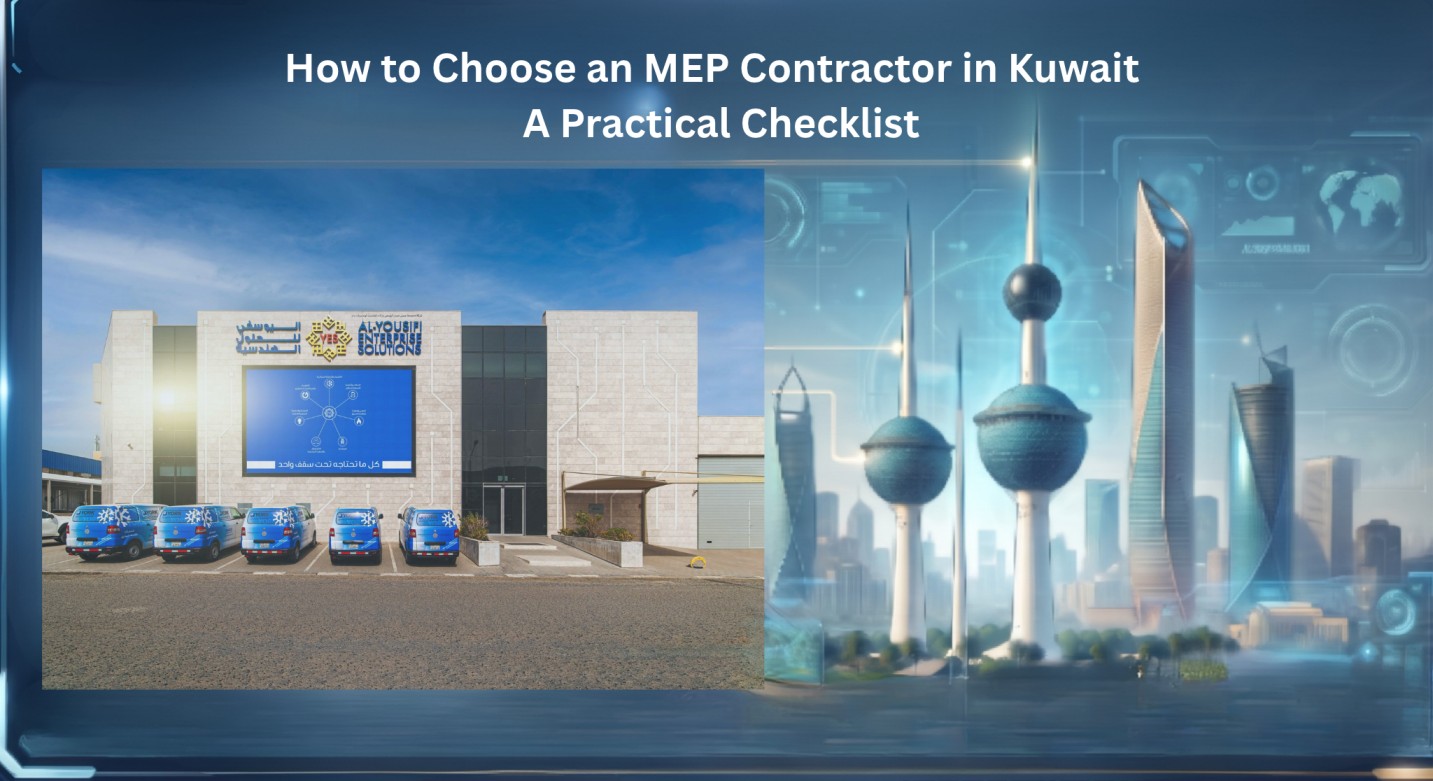
How to Choose an MEP Contractor in Kuwait:A Practical Checklist
Choosing an MEP contractor in Kuwait is a...
November 19, 2026
-
MEP Contractor
A building can have an impressive design and a sound structure and still fail its occupants if the air conditioning struggles in August, the power supply trips, or the drainage backs up. In Kuwait, where summer temperatures regularly pass 45°C and dust is constant, mechanical, electrical and plumbing (MEP) systems decide whether a building is comfortable and reliable or a source of complaints.
This article explains what a professional MEP contractor in Kuwait actually does across a project, from the first drawing review to long-term maintenance, and where that work protects your budget, schedule and the building’s performance. If you are instead looking for guidance on selecting a contractor, see our companion guide How to Choose an MEP Contractor in Kuwait: A Practical Checklist
Most costly MEP problems begin during the design stage. Ducts, pipes, cable trays and sprinkler lines all compete for the same ceiling and riser spaces. They must also work around beams, columns and architectural features.
A professional MEP contractor reviews the design and prepares coordinated shop drawings, ideally supported by 3D clash detection. This helps identify and resolve conflicts before construction begins.
This stage typically involves:
Every clash identified during the design stage helps prevent unnecessary demolition, reinstallation and additional project costs.
Generic designs and standard equipment choices often underperform in Gulf conditions. An experienced MEP contractor understands the environmental challenges in Kuwait and plans systems accordingly.
Key considerations include:
Extreme Heat: Cooling systems must be designed for peak summer temperatures rather than average conditions. Condensers and outdoor equipment also require adequate airflow and shading to maintain performance.
Dust and Sand: Proper filtration, coil protection and cleaning access are essential in dusty environments. These measures help maintain equipment efficiency and extend its operating life.
Humidity and Salt Air: Coastal projects require corrosion-resistant materials and protective coatings for pipework, supports and outdoor equipment.
High Cooling Demand: Air conditioning accounts for a significant share of electricity consumption in the region. Even small improvements in system efficiency can translate into meaningful long-term savings.
Poor installation is difficult to identify once ceilings and walls are closed, but it can lead to recurring problems such as leaking joints, noisy ducts, overheating cables and equipment that cannot be serviced properly.
Quality MEP installation requires:
Professional contractors also use Inspection and Test Plans (ITPs), with specific checkpoints where work is inspected and approved before it is concealed.
This approach helps ensure a smoother project handover and reduces the risk of future maintenance issues.
MEP installation takes place alongside civil, structural, finishing and façade activities. Proper coordination between these trades is essential to keep the project on schedule.
For example, sleeves must be installed before concrete is poured, first-fix services must be completed before ceilings are closed, and equipment deliveries must match the building’s construction readiness.
A professional contractor manages these activities by:
Most MEP delays can be traced to late procurement or unresolved coordination problems. Effective planning helps minimise these risks.
MEP systems involve live electrical connections, pressurised pipework, rotating equipment and critical life-safety infrastructure. Therefore, regulatory approvals and workplace safety are essential.
Depending on the project, coordination may be required with:
A competent contractor prepares the necessary technical submissions, arranges inspections at the appropriate stages and maintains clear project documentation.
On-site safety practices include risk assessments, permit-to-work procedures, appropriate Personal Protective Equipment (PPE) and regular safety inspections.
Strong safety management protects workers and building occupants while helping prevent project stoppages and delays.
Installing an MEP system does not automatically mean it is ready to operate. Testing and commissioning verify that all systems perform according to their design requirements before the building is occupied.
Typical commissioning activities include:
The project then moves towards final handover, which should include:
Without proper documentation and training, building owners may struggle to operate and maintain their systems effectively.
Over a building’s lifetime, operating costs can exceed its initial construction costs. In Kuwait, air conditioning represents a major part of building energy consumption.
MEP decisions made during the design and installation stages have a lasting impact on electricity consumption and operational expenses.
Professional contractors can improve energy efficiency through:
MEP designs should also align with the applicable energy conservation requirements in Kuwait, which should be confirmed with the project consultant and contractor.
Rework is one of the most avoidable expenses on a construction site. It often results from uncoordinated drawings, incorrect materials, late design changes and rushed installation.
A disciplined MEP contractor reduces these risks through:
The benefits go beyond cost savings. Fewer corrections mean fewer delays, reduced material waste and a more organised construction site.
MEP equipment requires regular maintenance to deliver its expected service life, particularly in Kuwait’s dusty and high-temperature environment.
Preventive maintenance activities typically include:
A contractor familiar with the original installation can also troubleshoot problems more efficiently because they understand how the systems were designed, installed and commissioned.
Reliable technical support after handover helps reduce unexpected breakdowns, maintain system efficiency and protect the building owner’s investment.
A successful construction project depends on more than structural design and architectural appearance. Proper MEP planning, installation and maintenance play an equally important role.
Here are the key points to remember:
Choosing an experienced MEP contractor in Kuwait helps ensure that mechanical, electrical and plumbing systems are delivered efficiently and remain reliable throughout the building’s operational life.
Are you planning a commercial, industrial or residential development in Kuwait?
YES.com.kw can help you discuss your MEP requirements, request a site assessment and obtain a project quotation.
Contact YES.com.kw today to discuss your next construction project and MEP requirements.